
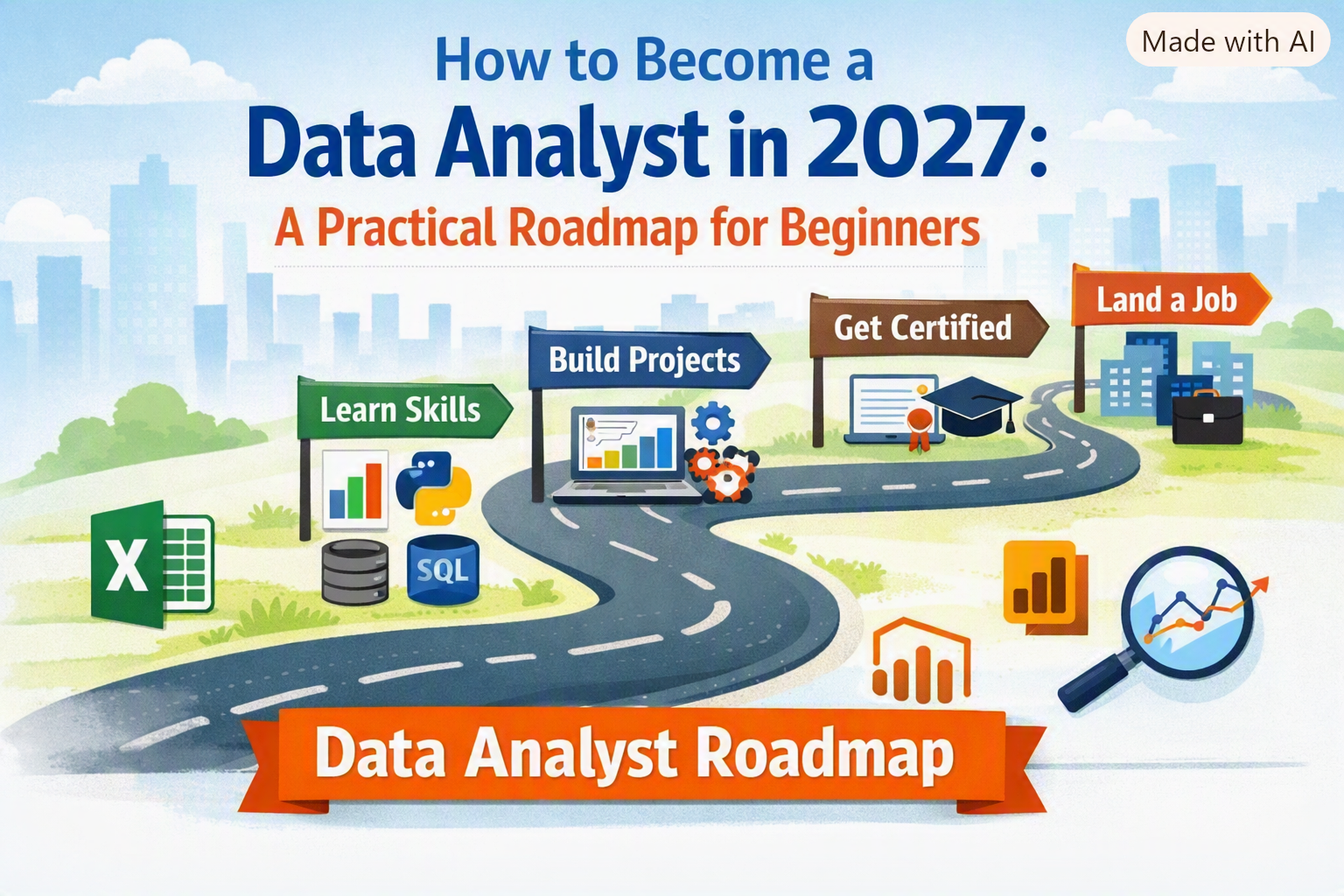
How to Become a Data Analyst in 2027: A Practical Roadmap for Beginners
Data is everywhere.
Every time you make an online payment, order food, watch a video, search Google, or purchase something from an e-commerce website, you create data.
But data itself is not valuable until someone can understand it and turn it into useful information.
That is where a Data Analyst comes in.
If you are a student, fresher, working professional, or someone planning to switch careers into technology, Data Analytics can be an exciting career option in 2027.
The good news?
You don't need to be a programming expert to start.
But you do need the right skills, practical experience, and a clear learning roadmap.
Let's understand how you can become a job-ready Data Analyst in 2027.
What Does a Data Analyst Actually Do?
A Data Analyst helps an organization answer questions using data.
For example:
-
Why did sales decrease last month?
-
Which product is selling the most?
-
Which customers are likely to leave?
-
Which marketing campaign generated the most leads?
-
Which region is generating the highest revenue?
A Data Analyst collects data, cleans it, analyzes it, creates reports and dashboards, and communicates meaningful insights to business teams.
In simple words:
A Data Analyst converts raw data into business decisions.
Skills You Need to Become a Data Analyst in 2027
You don't need to learn everything at once.
Focus on building your skills step by step.
1. Excel – Start With the Basics
Excel is still an important tool for working with data.
You should be comfortable with:
-
Formulas and functions
-
IF, SUMIF, COUNTIF
-
VLOOKUP/XLOOKUP
-
Sorting and filtering
-
Conditional formatting
-
Pivot Tables
-
Charts
-
Data cleaning
Don't underestimate Excel.
A beginner who understands Excel properly can already solve many real-world business problems.
2. SQL – One of the Most Important Skills
If you want to work as a Data Analyst, SQL should be one of your strongest skills.
Companies store huge amounts of information in databases. SQL allows analysts to retrieve and analyze that information.
You should learn:
-
SELECT
-
WHERE
-
ORDER BY
-
GROUP BY
-
HAVING
-
JOINs
-
Subqueries
-
CASE statements
-
Aggregate functions
-
Common Table Expressions
-
Window functions
For example, a company may ask:
"Show me the top 10 customers based on total purchase amount."
A Data Analyst should be able to solve that question using SQL.
3. Learn Python for Data Analysis
Python is another valuable skill for modern Data Analysts.
You don't need to become a software developer before learning Data Analytics.
Start with Python fundamentals and then focus on libraries used for data work.
The most important ones include:
-
NumPy
-
Pandas
-
Matplotlib
-
Seaborn
With Pandas, for example, you can load a dataset, clean missing values, filter records, calculate statistics and perform analysis.
Python becomes particularly useful when datasets become larger or when repetitive analysis needs to be automated.
4. Learn Data Visualization
A good analyst doesn't simply produce numbers.
They explain what those numbers mean.
This is why visualization is so important.
Learn how to create:
-
Bar charts
-
Line charts
-
Pie charts where appropriate
-
Histograms
-
Scatter plots
-
KPI cards
-
Interactive dashboards
You should also learn tools such as Power BI or Tableau.
The goal isn't to create dashboards that simply look beautiful.
The goal is to create dashboards that help someone make a decision.
5. Understand Statistics
You don't need advanced mathematics to begin your Data Analyst journey.
But you should understand basic statistics.
Start with:
-
Mean
-
Median
-
Mode
-
Percentage
-
Variance
-
Standard deviation
-
Correlation
-
Probability basics
-
Distributions
-
Outliers
Statistics helps you understand whether a pattern in your data is meaningful or simply random.
6. Learn Data Cleaning
Real-world data is rarely perfect.
You may receive data containing:
-
Missing values
-
Duplicate records
-
Incorrect dates
-
Spelling inconsistencies
-
Invalid numbers
-
Wrong formats
-
Outliers
This means data cleaning is a major part of an analyst's work.
You should become comfortable identifying problems and deciding how they should be handled.
7. Develop Business Understanding
This is where many beginners make a mistake.
They focus entirely on tools.
But companies don't hire Data Analysts simply because they know Python or Power BI.
They want people who can solve business problems using data.
For example:
Instead of saying:
"I created a sales dashboard."
You should be able to explain:
"The dashboard shows that sales declined by 18% in Region A, primarily because two major products experienced a significant drop in orders."
That is the difference between knowing a tool and thinking like an analyst.
Your 6-Month Data Analyst Roadmap
If you are starting from scratch, you can follow a structured roadmap.
Month 1 – Excel + Data Fundamentals
Learn:
-
Excel
-
Data types
-
Sorting and filtering
-
Formulas
-
Pivot Tables
-
Basic charts
-
Data cleaning
Build a small Sales Analysis Project.
Month 2 – SQL
Learn SQL from beginner to intermediate level.
Practice using real datasets.
Build queries involving:
-
Customers
-
Products
-
Orders
-
Revenue
-
Employees
Don't just watch SQL tutorials.
Write SQL every day.
Month 3 – Python
Learn Python fundamentals and then move into:
-
NumPy
-
Pandas
-
DataFrames
-
Data cleaning
-
Data transformation
-
Grouping
-
Aggregation
-
Data analysis
Build a practical Python data analysis project.
Month 4 – Visualization + Power BI
Learn:
-
Data visualization principles
-
Power BI
-
Data modeling
-
Relationships
-
DAX basics
-
Interactive dashboards
-
KPIs
Create at least two professional dashboards.
Month 5 – Statistics + Projects
Strengthen your statistics knowledge.
Then start building portfolio projects.
For example:
Project 1: E-commerce Sales Analysis
Project 2: Customer Churn Analysis
Project 3: HR Analytics
Project 4: Marketing Campaign Analysis
Project 5: Financial/Sales Dashboard
Month 6 – Job Preparation
Now focus on getting job-ready.
Prepare:
-
Resume
-
LinkedIn profile
-
GitHub portfolio
-
SQL interview questions
-
Python interview questions
-
Excel interview questions
-
Power BI interview questions
-
Data analysis case studies
-
Mock interviews
Start applying for jobs while continuing to improve your skills.
Don't wait until you feel 100% ready.
Build Projects, Not Just Certificates
This is probably the most important advice for beginners.
You can complete ten courses and collect ten certificates.
But during an interview, someone may ask:
"Tell me about a project where you used SQL and Python to solve a real problem."
You need a good answer.
Your projects should demonstrate:
Problem → Data → Cleaning → Analysis → Visualization → Insight → Business Recommendation
That's what makes a portfolio powerful.
What About AI in Data Analytics?
AI is changing the way analysts work.
In 2027, analysts will increasingly use AI-assisted tools for tasks such as:
-
Exploring datasets
-
Generating SQL drafts
-
Finding patterns
-
Creating visualizations
-
Automating repetitive work
-
Summarizing insights
But this doesn't mean the Data Analyst career is disappearing.
Instead, the skill requirements are evolving.
An analyst who understands business + data + SQL + Python + visualization + AI tools can become significantly more effective.
So don't try to compete with AI.
Learn how to work with AI.
Common Mistakes Beginners Should Avoid
❌ Learning too many technologies
Don't jump between Python, Java, .NET, AWS, Machine Learning and ten other technologies.
Choose a direction and build depth.
❌ Watching tutorials without practice
Watching someone analyze data is not the same as analyzing data yourself.
❌ Collecting certificates
Certificates can support your profile, but they cannot replace practical skills.
❌ Ignoring SQL
For Data Analyst roles, SQL is too important to ignore.
❌ Avoiding communication skills
An analyst must explain findings to people who may not understand technical terminology.
Learn to tell a story with data.
Can a Fresher Become a Data Analyst?
Yes.
You don't necessarily need years of professional experience to start.
But you do need evidence that you can perform the work.
A fresher should focus on:
Skills + Projects + Portfolio + Interview Preparation + Communication
Your first goal shouldn't be to become an expert.
Your first goal should be to become job-ready.
Final Thoughts
Becoming a Data Analyst in 2027 is not about learning every data-related technology available.
It is about following a focused path.
Start with Excel → SQL → Python → Data Visualization → Statistics → Projects → Interview Preparation.
Then gradually add advanced skills such as automation, cloud technologies, AI-assisted analytics and machine learning according to your career goals.
And remember one thing:
Your career doesn't change when you finish watching a course. It changes when you start applying what you learned.
If you are serious about building a career in Data Analytics, start today.
Learn one skill.
Solve one problem.
Build one project.
Then repeat.
Your 2027 career can be built one practical skill at a time.
🚀 Want a Guided Data Analytics Learning Path?
Learning alone can sometimes become confusing. You may spend months jumping between YouTube videos, courses and technologies without knowing what to learn next.
At Escon Info Systems, our focus is on helping students, freshers and working professionals build practical, industry-oriented technology skills through structured learning and hands-on projects.
If your goal is to move from “I want to learn Data Analytics” to “I am ready to apply for Data Analyst jobs,” a structured learning path can help you get there faster.
Start learning. Build projects. Develop confidence. Prepare for the job you want.